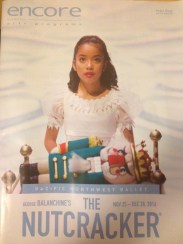
On Sunday I went to the Pacific Northwest Ballet performance of the Nutcracker. I danced ballet for 14 years, but I only attended the Nutcracker a few times throughout my life. I was genuinely excited for the performance, but was mentally prepared for some changes. In 2014, PNB retired their Kent Stowell and Maurice Sendak sets and costumes that had been in use since 1983. These sets and costumes were the ones I remembered from when I was younger. Last year, PNB premiered George Balanchine’s 1954 choreography with sets and costumes designed by Ian Falconer, author of the popular Oliva children’s books. I was pleased that the score, written in 1892 by Peter Ilyich Tchaikovsky, remained the same. I saw seated in the front row of the second tier, so I enjoyed an unobstructed view. During the second act, I used opera glasses to view the solo dances in greater detail.
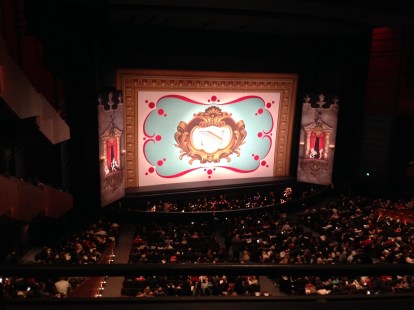
While I enjoyed the performance as a whole, there were a few elements that I could have done without. The beginning of the performance opened with a movie, a visual image projected onto a black drop of a train and a snowy town. It reminded me of the Polar Express, which I could watch for a lot less money at home. The purpose of the film was probably to help entertain young children during the orchestral prelude to the performance. As an adult viewer, I found the films (there was another one later) somewhat distasteful.

I felt there to be discontinuity between the brightly colored costumes and the themes of the first act, specifically Clara’s loud red and white striped dress and some of the other little girls in plaid. Herr Drosselmeier also got a new style with matching red and white stripes under his cloak. The bright colors make sense for the happy story, they just didn’t quite fit for me. Another addition I disliked were the wands with white pom-poms carried by the snow. This prop was added by Balanchine a few decades ago, but it really detracted from the snow scene (which is my favorite). The cotton balls didn’t do much for me. However, this thing I missed the most about this version was Clara’s transition from child to adult. In the Stowell version, Clara and her prince become adult dancers in the second act, performing an enchanting pas de deux at the end of the performance. In Balanchine’s version, Clara and her prince remain children, and the dance is performed instead by the Sugar Plum Fairy.

Despite the elements I disliked, there were many highlights and beautiful moments to be found in this performance. As I mentioned before, I was very pleased that the score had not changed. In addition, the musicians were superb (as always at PNB). My favorite piece of music in the performance is in Act 2, no. 14 pas de deux of the Sugar Plum Fairy and her Cavalier (in the other version it is danced her Clara and her prince). They kept the magical growing Christmas tree, which is one of my favorite parts of the performance.

Now for the dancing: my favorite performances of the night were the Peacock, the Candy Cane Man, the Sugar Plum Fairy and Dewdrop. The exotic Peacock has always been one of my favorite roles to see in the Nutcracker. I cannot commend the woman who danced the role, for some reason she was not listed in the program. Likewise, I am not sure who danced the role of the Candy Cane Man, since two times they informed the audience of a casting change for his role. His solo involved jumping his whole body through a hula hoop and turning jumps while inside the hoop. Of course, at the end of his solo he has to get the hoop over his whole body twice before he lands. Crazy town right there. As a long time attendee of PNB, I have become a big fan of Carrie Imler and her style. I was blown away by her performance of the Sugar Plum Fairy. Another one of the most challenging roles, Dewdrop, as danced by Sarah Ricard Orza. Both Imler and Orza were as effortless as the fairies they were cast to portray and I loved their performances.

 Walking with Wisdom