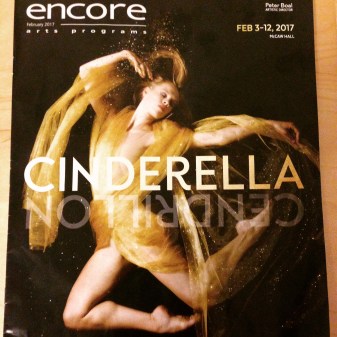
A work of fairytale romance told with exaggerated humor, the Pacific Northwest Ballet’s production of Cendrillon presents dance that turns the timeless tale on its head.
On Thursday evening, I attended a lecture and dress rehearsal of the production before seeing the finished product over the weekend. PNB artistic director Peter Boal joined guest artist Lucien Postlewaite for the lecture, in which they discussed his travels with touring company Les Ballet de Monte Carlo.
Following the lecture, I observed my first PNB dress rehearsal, which was an interesting and enlightening experience. Boal gave a disclaimer before the rehearsal commenced, asking the audience not to be too judgmental of the practice run. Of course, the work looked incredibly impressive, even though it was only practice. The experience gave me a greater appreciation for how much work it takes to create one of PNB’s world famous performances. Even hearing the orchestra go over different sections was interesting, exposing the process of refining the music.
This modern twist on the classic tale was choreographed by Jean-Christophe Maillot to the score written by Prokofiev in the 1940’s. Ernest Pignon-Ernest and Jerome Kaplan designed the sets and costumes and worked together on PNB’s most recent production of Romeo et Juliette. The sets were large, white rectangles that were reminiscent of pages torn from a gigantic diary. Another key set piece was a staircase featuring a slide, which the prince rides down on his entrance to the ball.
The plot is where this ballet takes its biggest turn from the Disney film- there is not a pumpkin, mouse or blue-hooded fairy godmother in sight. Maillot creates a mature narrative, drawing in the romance between Cinderella’s mother and father as a key relationship. The ballet opens with Cinderella grieving the loss of her mother, who has passed away from heart problems. Cinderella and her father remember her with a simple white dress. We soon meet the Evil Stepmother, Stepsisters, and Fairy Godmother, along with new characters including Pleasure Superintendents and Mannequins. The Fairy Godmother gives Cinderella a vision of the ball, which is acted out through a wild burlesque performed by the Mannequins. She meets the Prince at the ball, falls for him, and they live happily ever after. In addition, it is revealed that the spirit of Cinderella’s mother lives on in her life through the Fairy Godmother.
One of the most unique aspects of this production was that Noelani Pantastico, the dancer who was Cinderella, danced ballet barefoot for the entire performance. Rather than wearing glittery pointe shoes, her feet themselves were covered in glitter (enough to be seen from the second balcony). The program notes elaborate on this stylistic choice:
“Cinderella’s bare foot becomes a symbol of ballet. It symbolizes not only the simplicity and starkness of this young girl, but also a part of the body without which dance would not exist. The foot is the pivot of choreographic art, its pillar, its momentum, its take-off, and its survival.”
I found the simplicity rendered through the movement of the bare feet to be a brilliant choreographic choice. The artistry, choreography and setting of this work support one another in their efforts to effectively convey this classic narrative.
In addition to stylistic elements, the dancing in this piece was focused more on group work than solos. The dramatic spectacle of the ball scenes was successfully juxtaposed with the simplicity of the dual pas de deuxs between Cinderella/Prince and Mother/Father. I found the acting in this work to be more integral to the story than even the dancing itself. Every dancer was so invested in embodying their character, I expected them to act that way all of the time. All dance steps were altered to convey a specific attitude, whether for good or for evil. The humor in this work was refreshing, clearly catering to a mature audience. The language of the piece assumes that we have seen this story before and are mentally prepared for a break from tradition.
While every dancer in this piece was superb, the dancer that stood out the most was April Ball, who danced the role of the Fairy and Cinderella’s mother. Like Postlewaite, she danced with Les Ballets de Monte Carlo as a soloist. Ball went on to perform in many of Maillot’s ballets, in roles that included the Lilac Fairy in La Belle and Juliet in Romeo et Juliette. Maillot created roles specifically for Ball as well. In 1994, she won a silver medal at the International Ballet Competition and gold at the Rudolf Nureyev International Ballet Competition.
As the fairy, Ball literally never stopped moving. Feet, hands, wrists, head and neck were constantly twitching, wiggling or whirring, suggesting abilities of flight. Her costume of a simple, flesh-toned skirt and crown was my favorite of the entire production. The loveliest aspect of her ensemble was the iridescent glitter that covered her whole body (that must be fun to remove every night). For me, Ball’s energy, spunk, charisma and stamina were astounding. Using only dance, her Tinkerbell-inspired performance was filled with both wit and wisdom.
If you are looking for a humorous, fresh twist on a classic Disney tale, look no further than PNB’s production of the Cendrillon. Sublime acting, genius choreography, whimsical costuming and sets come together to create a modern masterpiece for the next generation.
 Walking with Wisdom