
On the last Friday of spring break, I had the incredible opportunity to meet Misty Copeland, an African-American principal dancer at American Ballet Theatre.
With deep roots in European tradition, ballet is an art form that has been historically dominated by white dancers. For much of her time at ABT, Copeland has been the only black woman in the company.
In 2015, she was promoted to principal dancer, which is the highest possible rank in a company. This historic promotion made Copeland the first African-American woman to achieve this rank in ABT’s 75 year history.
When I first saw online that Copeland was giving a lecture at UW, I did not seriously consider the opportunity. She was coming on a Friday night, which is a day that I typically have other commitments.
After a friend told me the event was during spring break, I got online the following day to purchase a ticket. However, the event had already completely sold out! I was not surprised, since Copeland is currently one of the most well-known dancers in the United States, even by those outside of the dance community.
When another student opened the event to students in the dance program, I jumped at the chance. When I arrived, I was given a yellow wrist band and told to wait in a certain area of the performance hall.
The other students and I were lead back into the green room for our pre-lecture Q&A session. After 20 minutes of nervous chatter, a 5’ 2” Misty Copeland walked through the door, dressed casually in a sweater and jeans. I sat in the front of the group of chairs, placing me within arms’ reach of the dancer.
When I had the chance, I asked about the creation of her memoir, Life in Motion. Who convinced her that her story was important to share with the world, beyond the dance community? Copeland explained that as an introvert, writing was, and still is, her main form of self-expression. She had accumulated stacks of journals over the years, detailing the highs and lows of her life experience.

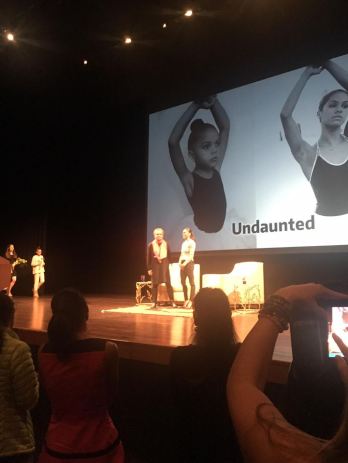
After half an hour, we moved into the main lecture hall, which was filled with people from all walks of life. What stood out to me the most about Copeland was her genuine, down-to-earth character. She explained that she doesn’t take offers or promote things that she does not believe in.
When asked about her new identity as a “celebrity” or “famous person,” Copeland broke down in tears. She has never sought to be famous, have fans or become a “success.” Her ultimate desire is to make ballet an art that anyone can see themselves doing, regardless of their physical appearance.
Following the lecture, I purchased a copy of Life in Motion for Copeland to sign. I got in line behind a little girl and her mother, who brought two of Copeland’s storybooks to be signed. As we approached the table, the girl’s mother pulled up a photo on her cell phone. As the security guard reminded her, “No pictures, you only get the signature,” she replied, “I know, I just want to show her this photo.”
I caught a glimpse of her phone screen as it turned, noticing an image of Copeland beside one of her little girl. At that moment, I realized the little girl was Lola, a local celebrity as a result of her mother’s photos she shared during Black History Month. One of the women she dressed up as was none other than Misty Copeland.
(Here is a link to Lola’s article: http://www.seattletimes.com/life/5-year-old-kent-girl-recreates-iconic-photos-for-black-history-month/)
I am thankful to say I have met Copeland and to have caught a glimpse of her true character. Book tours must be exhausting, but they must be a breeze in comparison to dancing in a ballet company. I predict that regardless of her season of life, Copeland will always be a role model and cultural figure, forever living life in motion.
 Walking with Wisdom