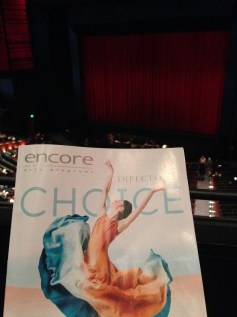
As their 2016-2017 season starts winding down, Pacific Northwest Ballet recently presented Director’s Choice, a program consisting of three modern ballets. For me, these works were the embodiment of choreographic diversity. Each brought its own flavor to the program while simultaneously complementing the other works.
Empire Noir by David Dawson
With dark costumes, stark lighting and an enchanting score, the opening piece was my favorite of the three works. Dawson’s training as a student of William Forsythe was evident in this piece, which was characterized by long lines of the arms and legs. Time passed quickly in the piece, forcing the dancers to remain in constant motion. The use of space was linear, marking direct pathways through the stage. Angles rather than curves were created by the dancers as they moved in synchrony with notable musicality. The placement of the backs, arms and hands of the women in this piece were incredibly interesting- sort of like Forsythe meets Swan Lake. Dawson draws heavily on his dance training, using the techniques he has learned as a boundary which he can extend through and beyond.
Out of the three pieces, I found Empire Noir to be incredibly moving. The work compelled me to feel indescribable emotions, despite the lack of a traditional narrative or characters. To me the score felt like the rising action of a movie or novel, swelling as the main character embarks on a dangerous journey. I felt the circular patterns and spinning motions to represent time. Themes of life, death, time and darkness are ingeniously conveyed through Dawson’s abstract modern ballet.
New Suite by William Forsythe
I had no knowledge of Forsythe before taking dance history last quarter at UW. We viewed his teaching methodologies CD ROM materials and worked in the studio with moving on a line, room writing and points in a cube. His approach to dance is unusually mathematical and geometric, requiring intense visualization and constant focus from dancers. I spent most of this piece tracking lines, points in space and connections, which was fascinating for me. Forsythe’s approach results in quirky, unconventional movements that are anything but expected.
This work consisted of eight pas de deuxs that were similar, yet each one had it’s own “flavor.” One particular scene that stood out to me was a couple costumed in dark blue. Their choreography had the most melancholy tone of the piece, ending in lighting that faded into darkness. I was dismayed by the lack of emotion conveyed through this piece. However, the geometry and choreographic risks of Forsythe’s work made it a visual pleasure.
Her Door to the Sky by Jessica Lang
I first experienced Lang’s work earlier this year when her company performed at Meany Hall. I enjoyed her work immensely and was excited to see another one of her works on the program for Director’s Choice. Lang’s work was created specifically for PNB and inspired by iconic Georgia O’Keefe paintings. Long-skirted costumes painted in bright, swirling colors created the embodiment of a living painting. Curved arms and opening gestures indicated the blossoming of plants in a garden. The dancers moved freely through the brightly lit space, embracing the energy of nature.
The set for this work included a “door” and “windows,” which were no more than rectangular spaces set in a simple backdrop. One of the women appeared in the door, and at the end she was lifted through it, moving into another space outside of the bounds of the stage. Lang’s work was bright and natural, personifying the freshness of plants following a spring rain.
Overall, the program allowed PNB to express their creative abilities by breaking away from the conventions of traditional ballet. If variety is the spice of life, Director’s Choice certainly fits the bill.
 Walking with Wisdom