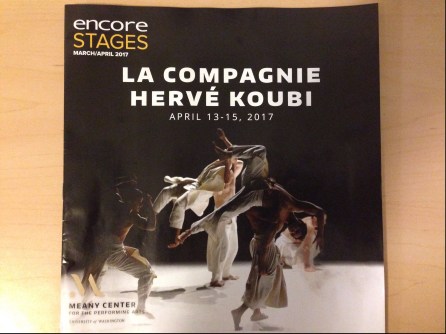
Last weekend I attended the final performance of La Compagnie Hervé Koubi at Meany Hall. I was mentally prepared to unwind and enjoy the show, but this company had other ideas. I found myself on the edge of my seat, following each unexpected twist, turn and acrobatic trick.
Choreographer Hervé Koubi opened the performance by sharing an anecdote of cultural self-discovery. Having been born and raised in France, Koubi did not discover that his parents were Algerian until much later in his life.
The uncovering of his family history had tremendous influence on Koubi’s choreographic work, leading him to dance and choreograph in Aix, Marseilles. He went on to dance the Centre International de Danse de Rosella Hightower in Cannes and the Opera of Marseille.
The company is composed of thirteen male Algerian and Burkina Faso dancers, three of whom could not obtain visas to enter the United States and perform. The performance went on, featuring ten dancers rather than thirteen. The dancers were all former street performers with no formal dance training.
“I met these dancers at an organized audition in October of 2009 in Algeria. Ever since, my enthusiasm never ceases to grow because of their pleasure in dance, always remaining open for the dance roles imposed for a creation, where I try to stay away from creating the spectacular just for the spectacle; but prefer to create something where the musicality of each dancer, of each body is in the service of the purpose of the performance.” – Hervé Koubi
That evening, the company performed Ce Que Le Jour Doit Á La Nuit, which is loosely based on a novel of the same title, written by Yasmina Khadra. Both the main character in the novel and Koubi share the experience of embarking on a journey of self-discovery. The dance reveals that this path is composed of many interconnected stories, held together as if part of a piece of lace. Throughout the piece, the contrasts between day and night are reflected in the blending of time, space and stories.
Overall, I found this performance to be both mesmerizing and surprising. Koubi’s work rejects perfect unison, displaying the dancers in near unison at several different moments. For much of the first portion, the dancers faced the back of the stage. The elimination of facial connections drew attention to the physical shapes being made by the bodies of the dancers.
One of the most fascinating elements of this performance was Koubi’s use of rotation, elevation and suspension. These men were equally adept in executing a wide variety of dive rolls, spinning jumps and cartwheels. The dancers were capable of spinning their entire body weight on one hand, a feat which progressed into rotating on the top of the head at high speed.
Elevation was included in a series of aerial cartwheels, backflips, tosses and jumps. The work included a continuous stream of jumps, falls, and lifts, often from great heights. In slower moments, gravity was suspended through headstands and lifts, with one man carrying another across his back.
In addition, the choices of lighting and costume were integral to the impact of the piece. Opening in a hazy, half-light, the audience is intrigued by a writhing mass of bodies in a heap on the floor. Lighting remains soft through much of the piece, transitioning at times from light to dark. Eventually, the lights become circular, suggesting a disruption to the source, such as light falling through trees.
All of the men were dressed in white pants with a skirt-like piece of fabric coming down from the waist. These “skirts” flowed beautifully in the elevations and turns, adding another dimension to the physical representation of the movements.
I walked away from this performance utterly speechless. Koubi’s fascinating work presented an unusual blend of traditional dichotomies. The work was both unfamiliar and familiar, both serene and energetic. I felt myself being suspended in a space between appreciation for what I had seen and anticipation for what would come next.
By boldly blending traditional dance forms with hip-hop, contemporary and experimental dance styles, Koubi’s work defies the conventions of formal categorization, just as his phenomenal dancers adeptly defy gravity throughout their work.
 Walking with Wisdom